Battles have provided an exciting display between armies, as over the years, techniques and styles of warfare have evolved, though it has never been determined which is better. In this post, we will do a deep analysis of both eras of battles and give the CPA Judges the final verdict.

Battle Concepts
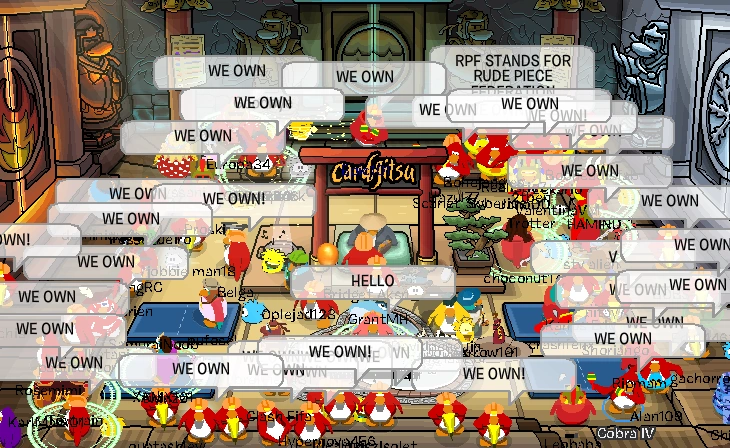
Club Penguin Armies battles have, without a doubt, changed significantly in a lot of aspects. Most notably, the overall focus on tactic quality compared to today’s organized environment. The concept of having to focus more on formations at the time was uncommon, with size having the significant bigger cut in determining a winner. Once it came to close battles in size, conflicts would always rise as each side will pro-claim a victory.
Different concepts were also used pre-CPPS to determine how land was invaded and how an army can win. A series of activities would take place in various rooms to determine the winner of a server battle, as the attacking army tries to cover most of the server’s room while the defending army counters. All this leads you to conclude that old battles were not something that had a motion of events already pre-determined to happen for the armies to have the upper hand in. Battles were simply a matter of scheduling a time on your website, logging on in the server you want to claim and having the size advantage in all of the rooms you enter.
Nachos invasion of Mammoth, 2013.
Leading Styles
When we talk about battle styles, we will have to talk about leading styles in said battles. These vary from the formations used, the tactics used, how you relay your tactics, which bombs you perform, and the time you take to move. The important thing about this is that it varies from each leader and army, though it follows a similar threshold per historical period. You would not see a leader ten years ago call an infinity or boat formation, and likewise, you would not see a leader today do a wipe bomb or one liner tactics. Despite the worn-out tactics of previous eras, they remained effective in the styles of battle that were present at the time.
As mentioned above, current leaders all across the community focus on rapid fire and organized formations, as the combination of these two gives a clear sight of cohesion in performance. A lot of focus goes into making sure the formation does not have gaps and bunching, something which is instantly called out. In today’s battle landscape, formations are the first pillar of battle strategy in order to win. In older eras, this wasn’t the case, as many battles were conducted outside the battlefield, with the use of politics. When it came to the actual battles, the common style of battle was just to overshadow and outrank the enemy in any way possible, most importantly, size.
Comparison Between The Two
When we look at the two eras, both follow the same metrics, though they vary in terms of importance. A lot might suggest that newer eras would topple older eras, but that could be due to the criteria we set for ourselves today. It would be unfair to compare the two when they were both in different standards at their time.
On paper, an army today, like the Aliens, could potentially beat an army from 2017, like the Nachos. The very fast-paced leading style of today could obviously overwhelm many older armies. To properly compare the two, we would need a clear mind going into the comparison and see which one is ultimately better, taking into consideration many factors to put them on equal footing.

To run this comparison, we contacted Head Judge T_T to conduct an analysis on two battles. The first one is from 2014, showing a battle between the Dark Warriors and the Rebel Penguin Federation. The second one shows a recent battle between the Void Troops and Templars. We tried as much as possible to find battles similar in size and intensity to run a proper comparison between the two eras.
T_T: [VT v TCP | Modern Battle] VT are in a UT form, with TCP in an X, the two armies exchange a flurry of emotes & tactics, both armies having relatively similar speed, both also hold their tactics equally well. VT though has the quicker tactic completion, their troops as a whole being faster at pasting tactics then TCP. Formation wise, VT has the edge. Both armies are quite spread out in their formations, at a glance looking equally large but VT’s formation has a smaller, better troop spacing for their size whilst TCP are spread out quite thin, making it clear that they’ve attempted a formation too large for their size.
VT gradually slow down as the 3 minute mark approaches, the center of their vertical noticeably having an afk or two. Both armies exchange BWBs, followed by VT moving first, raking into a + form whilst TCP rake into a V. Neither army in particular dominated during the movements, VT were however decently quicker into form than TCP. TCP are better in their V, utilizing their size well via spreading out whilst maintaining clean, even troop spacing, finding the perfect balance between form size & spacing, overall being a very well executed form. VT’s formation was somewhat of a downgrade from their previous formation, as they weren’t able to spread out as much as before, making them look smaller compared to TCP. Both armies had a similar form cleanliness. Tactic speed seems to be quite similar, with tactic completion also being effectively even.
From a judging perspective, battles today are analyzed through the same few metrics related to tactics, formations & movements, with leading being done in a formulaic manner. In terms of leading, a lot of the competition with battles today arises in being able to adapt to your opponents moves as well as knowing what formations work and don’t work in a given room. With both armies pretty evenly matched, this battle serves as a great example of what the structure for battles looks like in the modern era of CPA.
[DW v RPF | Older Battle] DW are in an X whilst RPF are initially in a vertical, expanding out to a UT formation. DW were slightly quicker to completing their tactics, however alongside RPF they didn’t hold their tactics for nearly long enough, resulting in noticeable gaps between each tactic. DW’s X formation looks decently larger within the room, with it also covering the top of RPF’s vertical, making them look much smaller in comparision. RPF’s formation was fairly messy, most notably so at the horizontal with several troops out of form. Both armies then move, RPF forming a +, with DW then settling into the same form. DW are far more visible in the room than RPF, covering them at the horizontal.
Whilst this battle can still be picked apart through a modern judging lens, there are a couple smaller aspects of it that differ from how modern day battles operate. One such case is the noticeable gap between the movements for both armies ending and the formations being called, showing a contrast to the intensely time pressured battles of today, where you would instead get penalized for not being quick enough into form.
T_T: Which is better? To be truthful, neither, both styles of battle are enjoyable in their own way. The less rigid structure of older CPA battles allow leaders more freedom to experiment and test out unusual formations with a far smaller risk of being penalized for it, whilst modern CPA battles have a much more fast paced element to them, and with the judging criteria being clearly laid out, you can often discern who might be winning an exchange, making the viewing experience more enjoyable in that aspect especially for close battles. To use an analogy, its like watching a street fight compared to watching an MMA matchup. Street fights are entertaining in how its just two people duking it out with no set of rules, adding a sense of unpredictability and suspense. On the other hand, MMA battles are fun to watch as you have two heavily trained fighters, brawling it out with a specific technique to each blow, with the spontaneous nature of the fight making it super thrilling to watch.
What T_T gives here adds more depth to the fact that each era of battles offers different techniques that are interesting in their own way. In present standards, battles have very specific measures of winning, following specific rules, resulting in a less unpredictable nature, though it remains exciting to watch. Old battles, as T_T mentioned, resemble more of a street fight, as the two armies try to win in their own fashion with minimal complications. It is the beauty of what makes battles through the years really interesting, as each era offers a more robust yet different and creative style of warfare for armies.
It is difficult to really call one better than the other, as both excel in their own way. It remains a matter of preference for the community to really settle, and how people see and experience these battles from their perspective. This post offers detailed information and details on each era, while giving you the final verdict on which is better and why. So what do you think? Which era of battle is better in your opinion, and why?